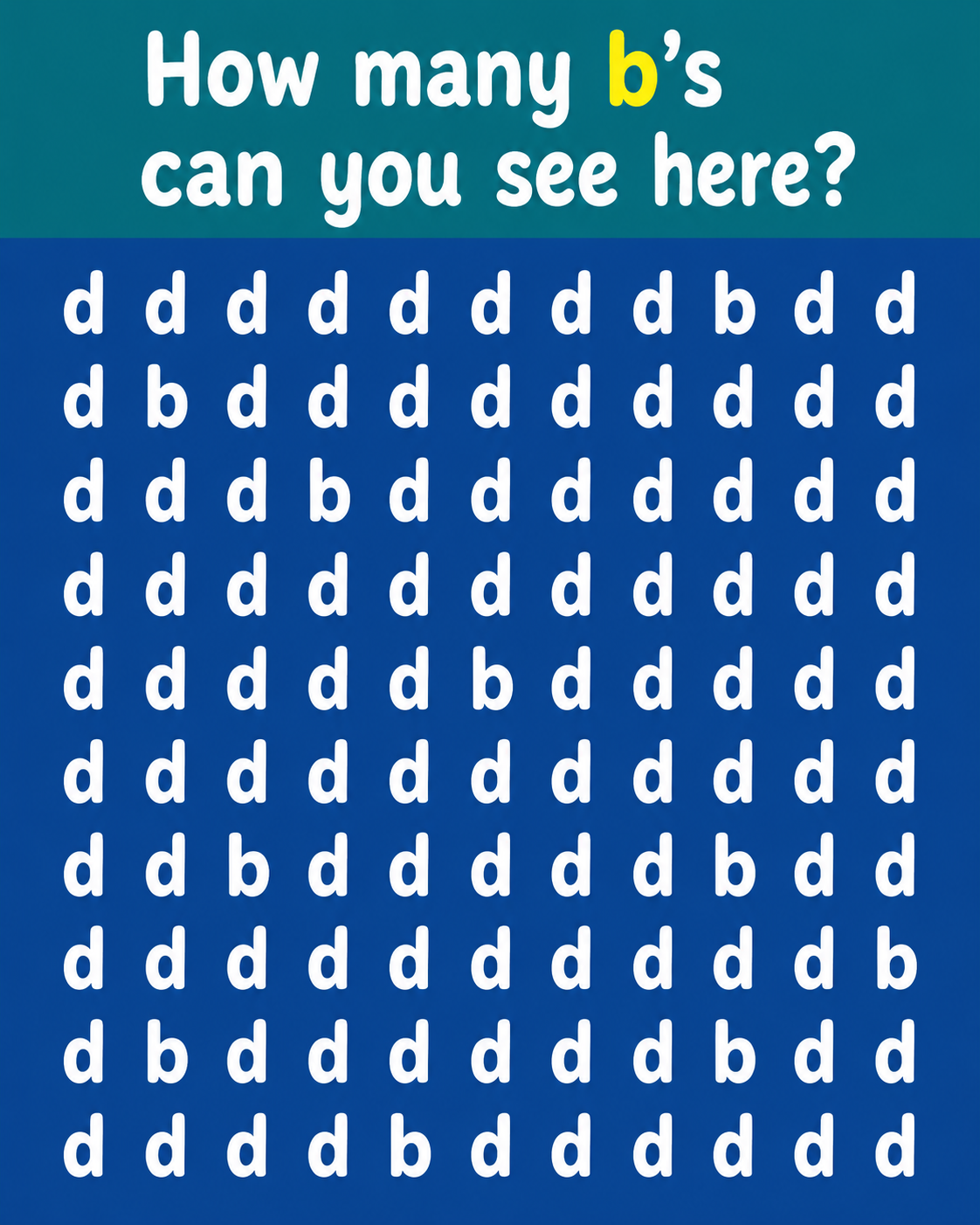
At first glance, it looks incredibly simple.
A grid full of lowercase letters, almost all of them “d,” with a challenge printed at the top:
“How many b’s can you see here?”
Easy, right?
You scan the image, spot a few obvious “b” letters hidden among the sea of “d” characters, make a quick count, and feel confident in your answer.
But then someone tells you that your count is wrong.
So you look again.
And suddenly you notice another one.
Then another.
Then yet another that somehow escaped your attention despite staring directly at it moments earlier.
This is exactly why visual puzzles like this go viral online. They appear simple enough for anyone to solve, yet they expose fascinating weaknesses in the way our brains process information.
The challenge isn’t really about identifying the letter “b.” It’s about attention, pattern recognition, concentration, and the surprising shortcuts our brains use every day.
Let’s take a deep dive into why this puzzle is so difficult, what makes so many people miss the correct answer, and what it reveals about human perception.
Why This Puzzle Is So Deceptively Hard
Most people assume that distinguishing between a lowercase “b” and a lowercase “d” should be effortless.
After all, they’re different letters.
The problem is that they are also mirror-like opposites.