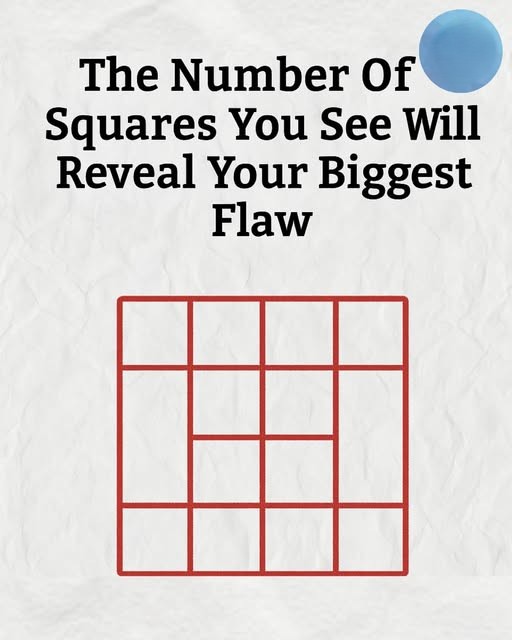
How Many Squares Can You See?

From an evolutionary standpoint, recognizing patterns helped humans survive. Detecting movement in tall grass or spotting shapes in the distance could mean the difference between life and death.

Today, that same ability helps us solve puzzles.

However, pattern recognition isn’t perfect.

Different people focus on different parts of an image. Some immediately notice larger structures. Others focus on small details. This variation explains why two intelligent people can arrive at completely different answers.

The puzzle becomes less about mathematics and more about perception.

So, How Many Squares Are There?

This is where things get interesting.

Many people rush to count only the obvious squares. They identify the smallest visible units and stop there.

More careful observers begin finding larger combinations.

Expert puzzle solvers often recommend a systematic approach:

Step 1: Count the smallest squares

These are the basic building blocks of the image.

Step 2: Count medium-sized squares

Combine neighboring squares to create larger ones.

Step 3: Look for even larger formations

Many puzzles hide giant squares that encompass multiple smaller ones.

Step 4: Search for unusual overlaps

Some squares aren’t immediately obvious because they share lines with other shapes.

The exact answer depends on the puzzle’s construction and how you define a square within the design.

That’s why online debates often explode under posts featuring this image.

Why Everyone Gets a Different Answer

There are several reasons why people disagree.