None of these traits are inherently good or bad.
They simply reflect different ways of approaching problems.
The Educational Value of Geometric Puzzles
Teachers frequently use puzzles like this in classrooms because they develop:
- Observation skills
- Mathematical reasoning
- Logical thinking
- Pattern recognition
Students learn that complex problems become easier when broken into smaller steps.
This lesson applies far beyond mathematics.
The Real Answer Hidden in the Puzzle
The most important lesson isn’t the number of squares.
It’s the process.
The puzzle reminds us that reality is often more complex than it first appears.
Two people can look at the same image and see different things.
Neither person is necessarily wrong.
They are simply observing from different perspectives.
In many ways, that mirrors everyday life.
People interpret situations differently based on experience, knowledge, and focus.
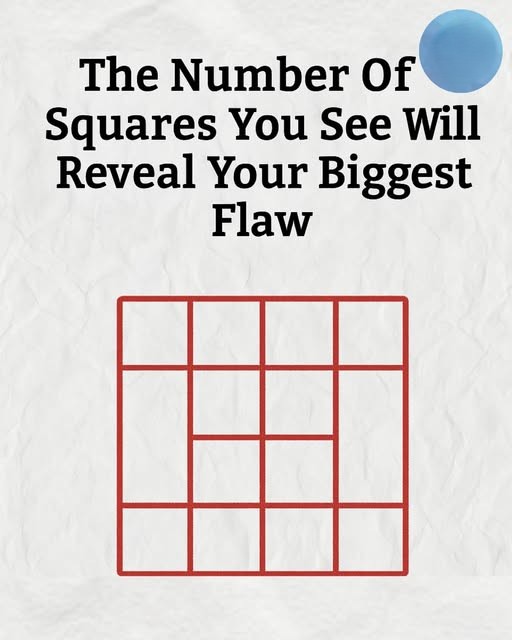
The square puzzle becomes a small demonstration of how perception shapes reality.
Final Thoughts
The viral square-counting challenge is more than just an internet distraction. It combines mathematics, psychology, perception, and curiosity into a deceptively simple image.