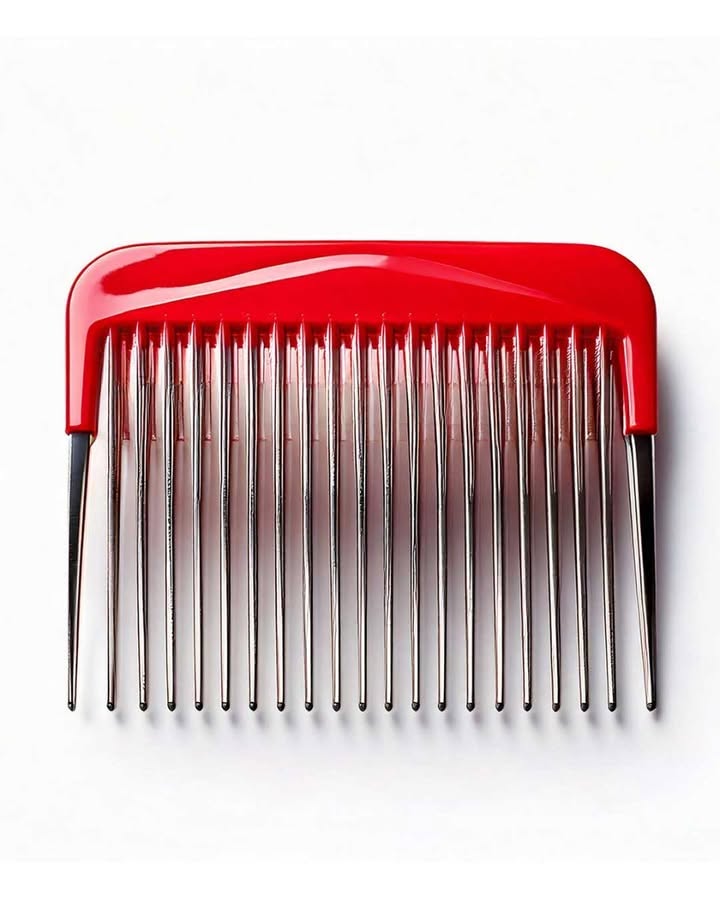
Have you ever opened an old kitchen drawer and discovered a strange object that seemed completely out of place? Perhaps it was tucked away among forgotten utensils, rubber bands, old batteries, and miscellaneous household items. At first glance, it looked like a tiny red comb with long metal prongs extending from one end. It certainly didn’t resemble any common kitchen tool, and it may have left you wondering what it was used for.
While many people might assume such an object belongs to some obscure cooking gadget or household device, the answer is actually much more interesting. The mysterious red object is most likely a hair pick—a grooming tool with a remarkable history that stretches back thousands of years and carries deep cultural significance.
Far more than a simple comb, the hair pick has played an important role in personal grooming, cultural identity, social movements, and self-expression. Its story spans continents, civilizations, and generations. What may appear to be an ordinary object hidden in a drawer is actually a symbol of heritage, pride, and resilience.
A Curious Discovery
Many household drawers become repositories for forgotten items. Over the years, objects are misplaced, stored temporarily, or simply forgotten. This often leads to surprising discoveries when cleaning or organizing.
Imagine finding a small red handle attached to several long metal teeth. The metal prongs are sturdy and widely spaced, unlike those of a traditional comb. It might seem too unusual for styling hair and too delicate for kitchen work.
Without context, identifying the object can be difficult. Some people guess it is a miniature rake, a decorative item, or even a specialized cooking utensil. Yet its true purpose is much simpler—it is designed specifically for grooming textured hair.
The wide metal teeth allow the tool to move through thick, curly, or coiled hair without causing excessive pulling or breakage. This design makes it highly effective for creating volume and maintaining natural hairstyles.
Ancient Origins of the Hair Pick
The history of the hair pick reaches back thousands of years. Archaeologists have discovered ancient combs and hair-picking tools in numerous regions of Africa, Asia, and the Middle East.
These early grooming implements were often carved from natural materials such as:
- Wood
- Bone
- Ivory
- Horn
- Shell
Unlike modern mass-produced products, ancient hair picks were frequently handcrafted. Many featured intricate carvings and decorative designs that reflected local artistic traditions.
Hair grooming held great importance in many ancient societies. Hairstyles often indicated social status, age, marital status, tribal affiliation, or religious identity. As a result, grooming tools themselves became valuable possessions.
In ancient African civilizations especially, elaborate hairstyles were common and required specialized tools for maintenance. The hair pick evolved as a practical solution for managing tightly curled and textured hair while also becoming an object of personal significance.
Hair as a Symbol of Identity
Throughout human history, hair has been more than a physical feature. Across cultures, it has served as a powerful symbol of identity and self-expression.
In many African societies, hairstyles communicated important information about an individual. Different styles could indicate:
- Family lineage
- Community membership
- Social rank
- Spiritual beliefs
- Life stage