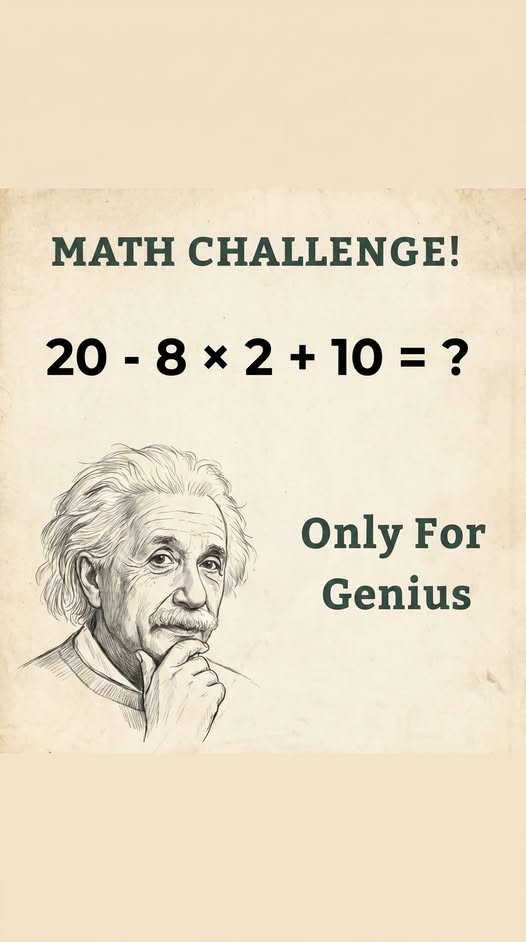
An expression like:
8 + 2 × 5
could have multiple answers:
- 50
- 18
- 40
depending on the order chosen.
Mathematics would become chaotic.
To prevent confusion, mathematicians established universal conventions so that every equation has one agreed-upon answer.
This standardization allows scientists, engineers, accountants, and students around the world to communicate using the same mathematical language.
Why Our Brains Fall for These Tricks
Interestingly, the challenge isn’t really about arithmetic.
Most adults can multiply 8 by 2 without difficulty.
The real test is whether you remember and apply the proper sequence of operations.
Psychologists have found that the human brain often relies on shortcuts when solving familiar problems.
When we see simple numbers, we tend to react quickly rather than analyze carefully.
This phenomenon is known as cognitive bias.
Math puzzles exploit this tendency by presenting straightforward calculations that tempt us into making hasty assumptions.
The Rise of Social Media Math Challenges
Platforms like Facebook, Instagram, TikTok, and X have turned math puzzles into a global phenomenon.